Indian workwear has a strong opportunity to move from a domestic commodity category into a
globally competitive export segment. The global market is not just looking for low-cost garments
anymore. Buyers are increasingly looking for dependable supply, technical capability,
customization, and value-driven manufacturing partners who can deliver consistency at scale.
This creates a meaningful opening for Indian brands and manufacturers that are ready to think
beyond volume and start thinking in terms of performance, compliance, and market positioning.
India already has several structural advantages. The country has a large textile and garment
manufacturing base, diverse raw material access, labor expertise, and long-standing experience
in apparel production. For workwear specifically, India can offer a strong balance of cost efficiency
and manufacturing capability. But global export success requires more than production strength.
International buyers expect standardization, quality discipline, documentation, lead-time reliability,
and a clear understanding of end-user requirements. This is where many Indian suppliers still
need to evolve.
The export opportunity is especially strong in sectors such as industrial workwear, hospitality
uniforms, safety apparel, logistics clothing, and role-specific utility garments. These categories
have consistent global demand because they serve essential industries. Unlike fashion-led
products, workwear is driven by function, durability, and repeat purchasing. That makes it
attractive for exporters who can build long-term buyer relationships and deliver dependable
product quality across multiple cycles.
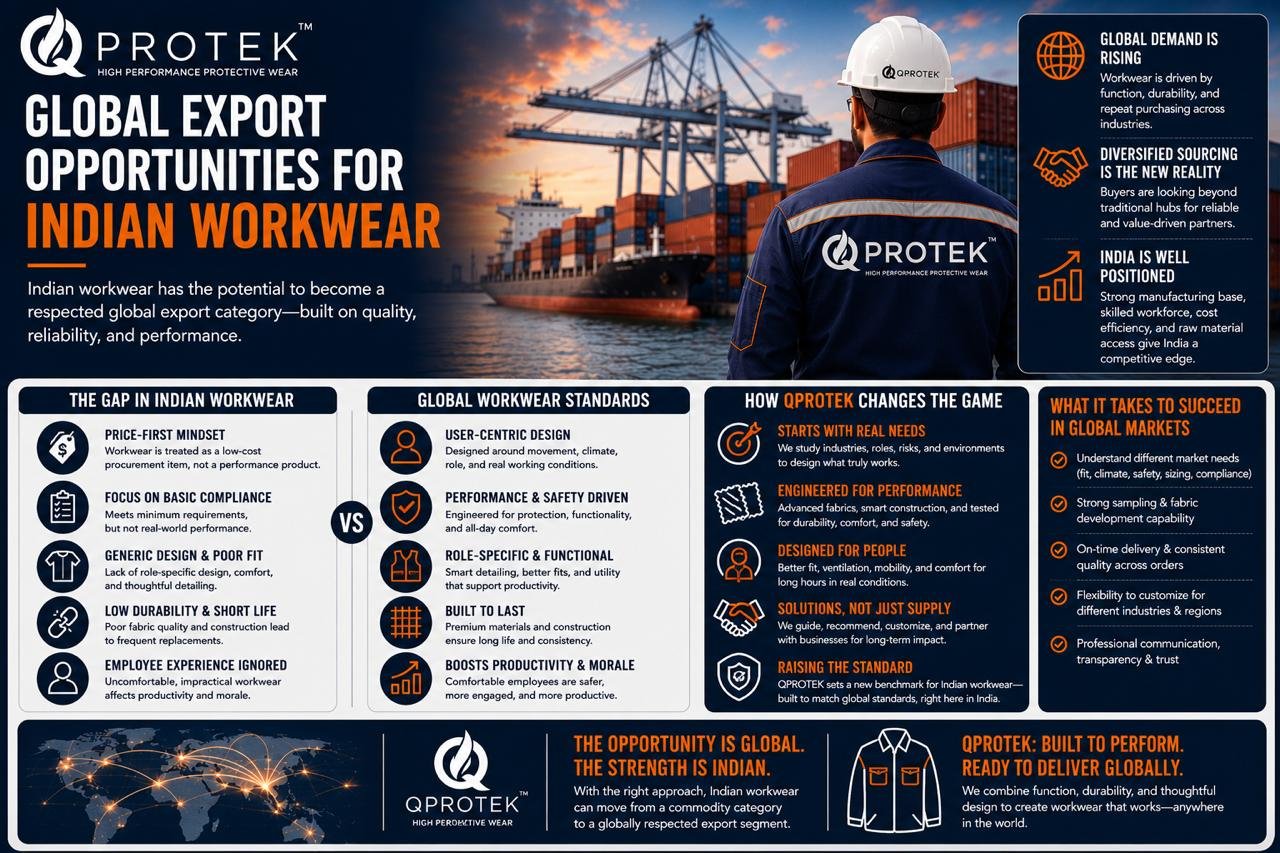
One of the biggest reasons Indian workwear exporters can succeed is the global shift toward
more diversified sourcing. Many international buyers are looking beyond traditional sourcing hubs
and seeking reliable partners in countries that can offer better value without compromising quality.
India is well-positioned for this transition, especially if suppliers can demonstrate strong sampling
capability, consistent fabric sourcing, responsible production practices, and the ability to
customize for different markets.
However, exporting workwear is not only about making garments that look good. Different
geographies have different expectations around fit, climate suitability, safety requirements, sizing
logic, and compliance. Buyers in Europe, the Middle East, Africa, and Southeast Asia may all
require different product specifications. A successful exporter must be able to adapt quickly and
design with the target market in mind. That means developing products that are not just
manufactured in India, but engineered for export markets.
This is where workwear brands can create differentiation. Instead of positioning themselves as
generic suppliers, they should present themselves as solution providers. That includes
understanding industry needs, offering technical fabrics, maintaining quality control, and building
trust through professionalism. The export buyer wants more than a garment. They want
predictability, responsiveness, and a supplier who understands commercial reality.
For a brand like QPROTEK, global export opportunities represent more than a sales channel. They
represent a chance to build a premium identity rooted in function, reliability, and thoughtful
design. If Indian workwear companies can combine manufacturing strength with product
intelligence, they can compete not just on price, but on value. That is the real opportunity.
The global market is open for brands that can prove they understand both the product and the
customer. Indian workwear has the potential to become a respected export category, but only if
businesses commit to higher standards in design, execution, and buyer experience. The next
phase of growth will belong to those who can translate India’s manufacturing depth into globally
relevant workwear solutions.